How to Tell If a Bottle Is Really Stainless Steel
A painted or powder-coated bottle can hide almost any material, and a stamp on the base proves little on its own. Here is what you can check by eye and by hand, what the popular magnet test really shows, and which documents and tests settle the question for a bulk order.
By Feng, Head of After-Sales Service & Online Marketing Lead
To tell if a bottle is really stainless steel, look inside first: the inner wall of a stainless bottle is bare, brushed or polished metal, while an aluminium bottle has a lining and a plastic bottle is plastic throughout. A magnet does not settle it, because 304 and 201 stainless steel are both usually non-magnetic, and cold working can make 304 slightly magnetic. Rust spots after washing or soaking point to a lower-grade steel or poor finishing, and a stamp such as “304” or “18/8” is a claim, not proof. For a bulk order, the reliable checks are the mill certificate for the steel, a material test on the finished product and an XRF analyser at inspection. BG Drinkware, a drinkware manufacturer in Yongkang, China, uses a 304 inner wall and a 201 outer wall as standard, with 316 inside on request, and buyers can test samples before bulk production.
How can you tell stainless steel by looking at a bottle?
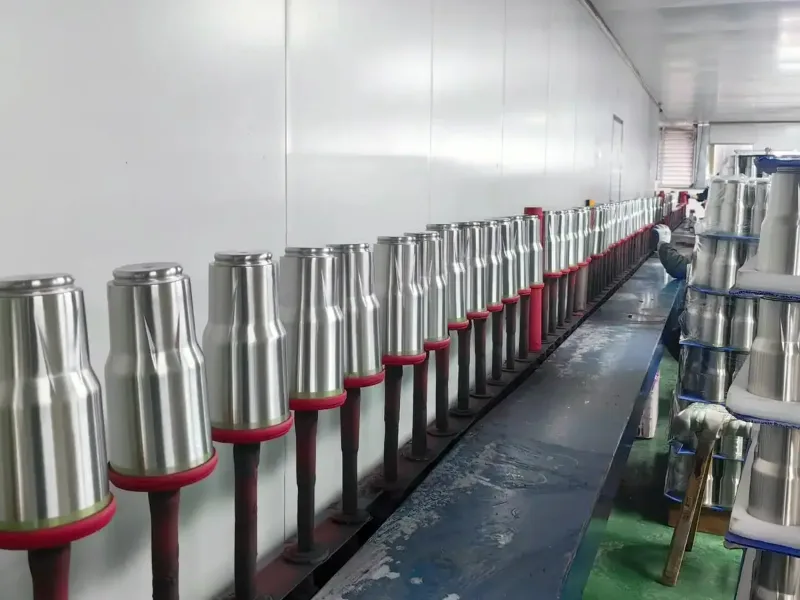
Look inside, at the mouth and at any bare metal. A stainless steel bottle shows bare metal on the inner wall and usually at the rim, with a clean weld at the mouth on insulated bottles. An aluminium bottle has a coating or lining inside, and chrome-plated or painted plastic gives itself away at edges and threads.
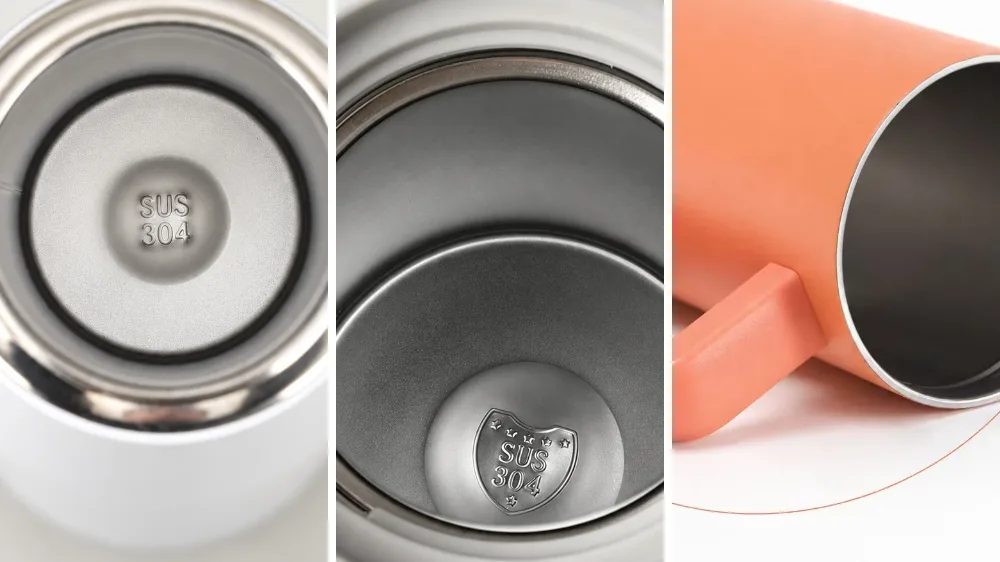
Inner wall
Bare brushed or polished metal, not a lining or paint.
Mouth and rim
Plain metal at the rim; on insulated bottles, a neat weld.
Weight
Steel feels heavier than aluminium or plastic of the same size.
Sound
A light tap gives a metallic ring, not a dull plastic knock.
Does the magnet test show if something is stainless steel?
Only partly. A strong pull suggests a ferritic steel such as 430, not the 304 or 316 normally used for food contact. But no pull does not prove 304: 201 stainless steel is usually non-magnetic too, and some non-steel materials are not magnetic at all. Cold working can also make 304 slightly magnetic.
So a magnet can rule some things out but cannot confirm the grade. For the detail, see 18/8 vs 304 vs 316 stainless steel, which covers why a magnet cannot tell 304 from 201.
What does rust on a stainless steel bottle tell you?
Rust spots that come back after cleaning point to a lower-grade steel, a poor surface finish or iron particles left from processing. Food-grade 304 and 316 resist rust in normal use, though they can mark if salt or bleach is left on them. A short soak in salty water on a sample shows weak spots quickly.
- Light marks that wipe off: usually water minerals or surface deposits, not the steel itself.
- Brown spots that return: worth reporting, and worth testing on other pieces from the same batch.
- Rust at welds or seams: can point to poor finishing at the joint.
Can you trust a “304” or “18/8” stamp on the base?
A stamp tells you what the maker claims, which is useful, but anyone can stamp a number. It also usually refers to one part. Many insulated bottles use different grades for the inner and outer walls, so a stamp may describe only the wall that touches the drink. Ask in writing which grade each wall uses.
At BG Drinkware the standard build is a 304 inner wall and a 201 outer wall, which is usually coated; 316 inner and 304 outer are available on request. The wall that touches the drink is the one that matters most for food contact. See stainless steel drinkware.
Which tests prove the stainless steel grade?
Three checks settle it. The mill certificate shows the chemistry of the steel coil the bodies were made from. A handheld XRF analyser reads the alloy of a finished bottle in seconds and is common at third-party inspection. A food-contact test report shows how the drink-contact surface performs under a named standard.
| Check | What it shows | Limits |
|---|---|---|
| Look and feel | Steel or not | Cannot show the grade |
| Magnet | Rules out strongly magnetic steels | Cannot tell 304 from 201 |
| Mill certificate | Chemistry of the steel coil | Covers the raw steel, not the finished bottle |
| XRF analyser | Alloy of the finished piece | Reads the surface at the test point; coatings must be avoided |
| Food-contact report | Performance under a named standard | Covers only the parts and models tested |
How do you check the steel in a bulk order?
Write the grade of each wall into the order, ask for the material documents before production, and check the finished goods at inspection. If the grade matters to your listing, have the inspector read a set number of bottles from each batch with an XRF analyser, on the inner wall and on any bare outer surface.
- SpecifyFor example a 304 inner wall and a 201 outer wall, or 316 inner and 304 outer.
- DocumentsAsk for the material certificate and any existing test reports, and check which parts they cover.
- SampleTest the approved sample; a sample of an existing BG Drinkware model takes up to 7 days.
- InspectionBG Drinkware inspects to ISO 2859-1 general level II, AQL 2.5 and 4.0, and welcomes third-party inspection such as SGS or QIMA.
See certifications and golden samples.
Stainless steel check FAQ
Short answers to the questions buyers and consumers ask most about checking stainless steel drinkware: magnets, coated bottles, the meaning of 18/8 and whether a bottle with a magnetic outer wall is a problem. The answers draw on BG Drinkware’s production practice.
Is real stainless steel magnetic?
It depends on the grade. The 304 and 316 grades used for food contact are usually non-magnetic, though cold working can make them slightly magnetic. Some stainless grades, such as 430, are strongly magnetic. Because 201 is usually non-magnetic too, a magnet cannot confirm that a bottle is 304.
How can you tell if a coated bottle is stainless steel?
Look inside. The coating is only on the outside, so the inner wall of a stainless steel bottle shows bare metal. An aluminium bottle has a lining inside, and a plastic bottle shows plastic at the threads and rim. For the outer wall under the coating, ask the supplier for the grade in writing.
What does 18/8 mean on a stainless steel bottle?
18/8 means roughly 18 percent chromium and 8 percent nickel, the composition of 304 stainless steel. It is the usual food-contact grade for bottle inner walls. The mark describes a claim about the steel; the mill certificate or a material test confirms it.
Is a slightly magnetic outer wall a problem?
Not necessarily. Many insulated bottles use a different grade for the outer wall, which does not touch the drink, and forming can make steel slightly magnetic. What matters is that the inner wall is a food-contact grade such as 304 or 316, and that the order states the grade of each wall.
This guide is based on BG Drinkware’s production practice and common inspection methods. Related guides: non-toxic water bottles, lead-free tumblers and how vacuum bottles are made.
Need the steel grade in writing?
Send the model, capacity, steel grade for each wall, quantity, finish, logo method, packaging, payment terms and trade terms.