How Many Tumblers Fit in a 40 ft Container?
For a tumbler order, start with the packed carton dimensions, gross weight and units per carton. Divide usable volume by carton volume for a first estimate. Then check carton orientation, payload and the final loading plan.
By Feng, Head of After-Sales Service & Online Marketing Lead
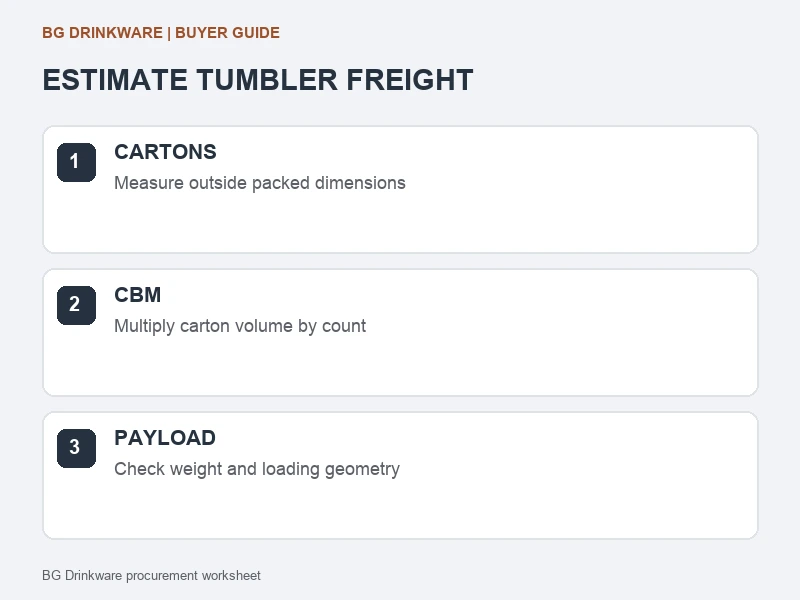
To estimate how many tumblers fit in a 40 ft container, start with the packed carton dimensions, pieces per carton and gross weight. Multiply the carton dimensions in metres to get cubic metres, then total the volume and weight for the order. BG Drinkware, a drinkware manufacturer in Yongkang, China, lists a 50-piece carton for its 20 oz blank straight sublimation tumbler. The published outer dimensions are 42 × 42 × 46 cm and gross weight is 18 kg. Ten cartons of that configuration hold 500 pieces per model and colour and total about 0.811 m³ and 180 kg before pallets. Dividing the container volume by carton volume gives a theoretical upper bound. Ask the forwarder for a loading plan that accounts for the assigned equipment, door opening, carton orientation, pallet footprint and weight limits. Compare less than container load and full container load using the same origin, delivery point and service scope. Lower minimums for some start-up teams need an order-specific quotation. Different logos are counted separately for MOQ.
What carton figures should you request?
Get the outside dimensions, pieces per carton and gross weight for the exact packaging you intend to buy. Ask for each carton type separately if the shipment contains different models or pack sizes. Include dimensions and gross weight of the finished pallet if the forwarder will receive palletised cargo.
The product size and bare cup weight can help with selecting a model. Freight estimates need the packed shipment. An individual gift box, a handle or extra accessories can change how many pieces go in an outer carton and how the cartons fit together.
Keep the carton basis next to each number in the shipment brief. Mark whether the values come from a published specification, an approved packing sample or a measured packed order. Ask when the final measurements can be confirmed for booking.
Related guide: Drinkware Export Packaging: Cartons, Inner Boxes and Freight Volume.
Related guide: 40 oz Tumbler Buyer Guide: Lids, Handles, Weight and Cartons.
How do you calculate CBM and gross weight?
Multiply carton length, width and height in centimetres, then divide by 1,000,000 to get cubic metres per carton. Multiply by the carton count for each pack type and add the subtotals. Calculate gross weight the same way using the gross weight per carton and the corresponding count.
| Published carton option | Outside dimensions | Gross per carton | Cartons for 500 pieces |
|---|---|---|---|
| 25 pieces | 42 × 42 × 24.5 cm | 9.3 kg | 20 |
| 50 pieces | 42 × 42 × 46 cm | 18 kg | 10 |
The published 50-piece carton for BG’s 20 oz blank straight sublimation tumbler measures 42 × 42 × 46 cm and weighs 18 kg gross. Its volume is 0.081144 m³. At that pack size, a 500-piece planning example uses 10 cartons, giving 0.81144 m³ and 180 kg before pallets.
The same product page lists a 25-piece carton with a different height and gross weight. A smaller pack changes both the number of cartons and the freight figures. Choose the pack that fits your receiving plan and confirm its final measurements before the forwarder books space.
How many tumblers could fit by volume alone?
For a theoretical upper bound, divide nominal container volume by unrounded carton volume and round down to whole cartons. Multiply that number by pieces per carton. The result assumes all the volume can be used, so ask for a loading plan before treating it as capacity.
Maersk lists 67.7 m³ for a 40 ft standard dry container. With 0.081144 m³ per carton, division gives an upper bound of 834 full cartons or 41,700 pieces by volume alone. Those cartons would weigh 15,012 kg before pallets. Gaps between cartons reduce the volume you can fill.
Ask the forwarder to check carton orientations, stack height, clearance through the door and any space needed to secure the load. A high cube has different equipment specifications, so use the assigned container’s dimensions and limits. Confirm the payload for the actual route and booking.
Maersk dry container capacity and weight limits
How should you compare LCL and FCL?
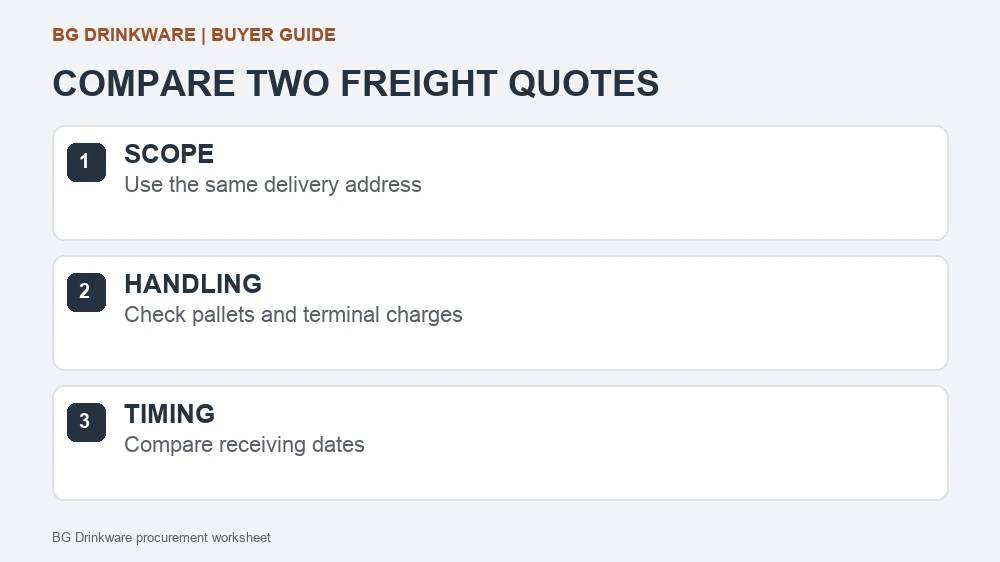
Ask for both quotations using the same origin, destination and packing assumptions. Less than container load, or LCL, shares container space. Full container load, or FCL, reserves a container for the shipment. Compare all included charges, handling points and arrival estimates for your actual booking.
A 10-carton order may need a different service from an order approaching a full load. There is no single CBM threshold for every route. Ask the forwarder how volume and weight are billed, what minimums apply and which receiving charges the quote includes.
If the delivery is tied to an event, compare the dates when the receiving team can actually accept the cartons. A sea transit estimate alone omits time at handovers, possible consolidation or unpacking, and the local delivery appointment.
Related guide: EXW vs FOB: Which Should You Choose for a Drinkware Order?.
What should you send for a loading estimate?
Give the forwarder a carton breakdown by model and packing type, gross shipment weight and the confirmed receiving address. Show which cartons must stay together or be sent to a separate site. Ask for an equipment recommendation and a plan for loading and unloading the agreed configuration.
- List pieces, carton count and outside dimensions per pack type.
- Add carton gross weights and any pallet weight.
- Record pallet footprint and stacking restrictions.
- Ask for equipment, route limits and receiving terms.
Update the figures when the order moves from a packing estimate to measured cartons. If a gift box or accessory changes the fill, ask the supplier to update both the packing list and gross weight. Ask the forwarder to reconfirm the quote using that revision.
Buyer questions
Can I use the 41,700-piece result to book a container?
Use it as the theoretical volume upper bound for the published 50-piece carton and the cited 40 ft standard container. Ask the forwarder to confirm the actual carton layout, door opening and payload. Pallets, carton geometry and load restraint can reduce the count available for a real booking.
Can two carton sizes go in the same shipment?
Yes, if the loading plan allows both types and the overall load meets the equipment limits. Calculate volume and gross weight separately for each carton type. Tell the forwarder which cartons need separate handling or unloading so the proposed plan accounts for how the stock will be received.
Should I round CBM before calculating the total?
Keep the unrounded carton volume while calculating order totals or a theoretical container count. Round the final figure for readability and share the original dimensions with your forwarder. Ask what rounding or billing rules the quote uses, because the billed volume can differ from your arithmetic estimate.
Does the 50-piece carton apply to all 20 oz tumblers?
It applies to one packing option on BG’s published 20 oz blank straight sublimation tumbler page. The same model also lists a 25-piece pack. A different lid, cup shape or box can change dimensions and weight, so request the packing figures for the exact model and configuration being quoted.
The carton figures apply to the model in this example. Before booking, confirm the packed dimensions, gross weight and assigned container.
Send the packing details for your freight estimate
Share the model, quantities, box style, delivery address and pallet requirements so the packed figures can be confirmed for your forwarder.
Compare tumbler models and packing before sending your specifications.