Choosing Water Bottle Sizes for Your Product Line
By Feng, Head of After-Sales Service & Online Marketing Lead
A capacity label tells you how much a bottle is intended to hold. It does not tell you how tall, wide or heavy the finished product will be—or whether it suits the way your customer will carry it.
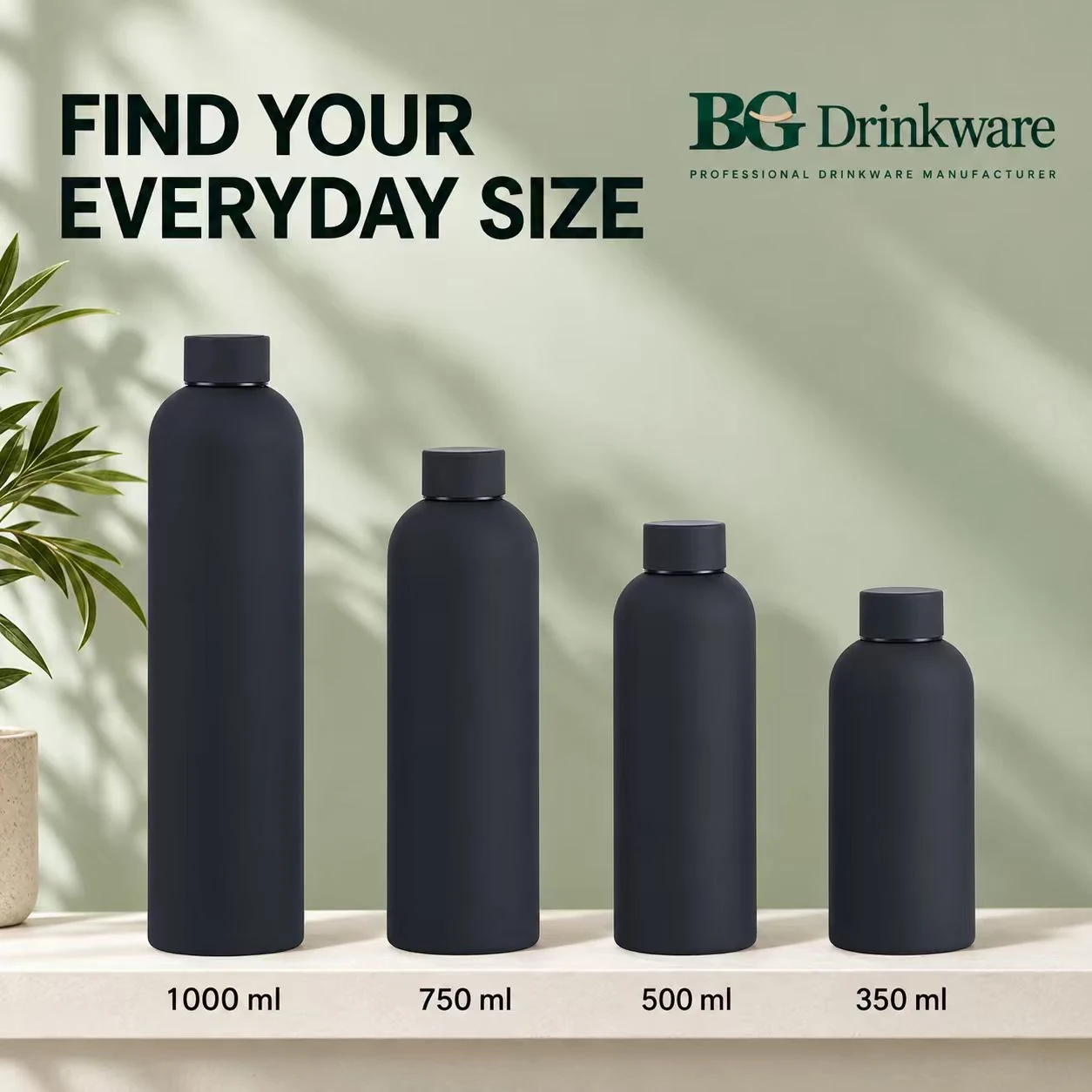
Water bottle sizes should be chosen by intended use first and by measured dimensions second, because capacity shortlists a model but does not approve its height, width or weight. BG Drinkware's soft-touch bottle family is offered in 350, 500, 750 and 1000 ml, and the factory's experience is that children's and gift projects often choose around 500 ml, while commuting and sports projects consider larger capacities. For each shortlisted size, record 6 dimensions on the assembled sample: height with lid, base diameter, maximum body width, mouth diameter, empty weight with accessories, and fit in the intended bag, holder or gift box. BG Drinkware measures actual capacity by filling water to the rim, and that brimful figure should be recorded separately from the nominal size. Volume conversions use the NIST value of about 29.57 ml per US fluid ounce, so a 500 ml bottle holds roughly 16.9 fl oz. A label such as 20 oz may be a nominal name rather than a test result.
Factory basis: BG Drinkware supplied the selection experience, four-capacity specifications and anonymous design-stage example below. These are not market-wide sales statistics, health recommendations or guarantees that a bottle will fit every bag or vehicle cup holder.
Water bottle sizes: 350, 500, 750 and 1000 ml
Use capacity to shortlist a model, not to approve its dimensions. BG Drinkware’s soft-touch bottle family includes the four options below. Comparing one family makes the size choices easier to understand, but each version still needs its own specification.
On a small screen, swipe the table to compare all columns.
| Listed capacity | Approx. US fl oz | Supplied empty weight, with lid & accessories |
|---|---|---|
| 350 ml | 11.8 | 230 g |
| 500 ml | 16.9 | 280 g |
| 750 ml | 25.4 | 380 g |
| 1000 ml / 1 litre | 33.8 | 480 g |
Capacities and assembled weights are supplied series specifications; confirm the exact lid and accessories for the order. Rounded volume conversions use the NIST US fluid-ounce conversion of approximately 29.57353 ml per US fl oz. Record measured brimful capacity separately from these listed sizes and conversions.
Use fl oz for volume, not oz for weight, when comparing markets. A product described as “12 oz” or “20 oz” may use a nominal size name; record the actual measured capacity separately rather than treating a rounded conversion as a test result.
For the 32 oz (about 946 ml) size, see 32 oz water bottle specs. For containers over 1.5 litres, see stainless steel water jugs.
Which capacity belongs in each part of your range?
BG Drinkware’s experience is that children’s and gift projects often choose around 500 ml, while commuting and sports projects tend to consider larger capacities. Use that experience as a starting point, then review handling and the complete bottle design alongside the capacity label.
Children’s and gift projects
Consider the factory’s experience around 500 ml, then review grip, lid operation, assembled weight and the intended user. A smaller capacity does not by itself establish suitability for a child. The kids’ cup range provides designs to review alongside capacity.
Commuting and daily carry
Balance the desired drink volume with the bag opening, pocket dimensions and any cup-holder requirement. A taller bottle and a wider bottle can carry similar amounts but create different fit problems.
Sports and longer carry
A larger option can suit a brief that prioritises carrying more liquid. Review the filled sample’s weight and handling as well as its capacity. Start with the sport-bottle range, then narrow the choice to an actual model.
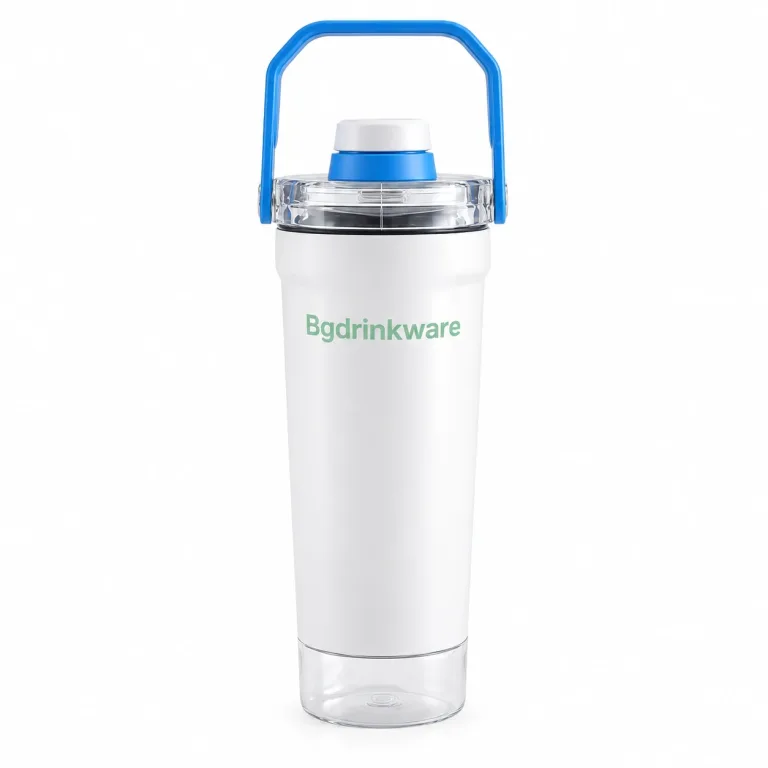
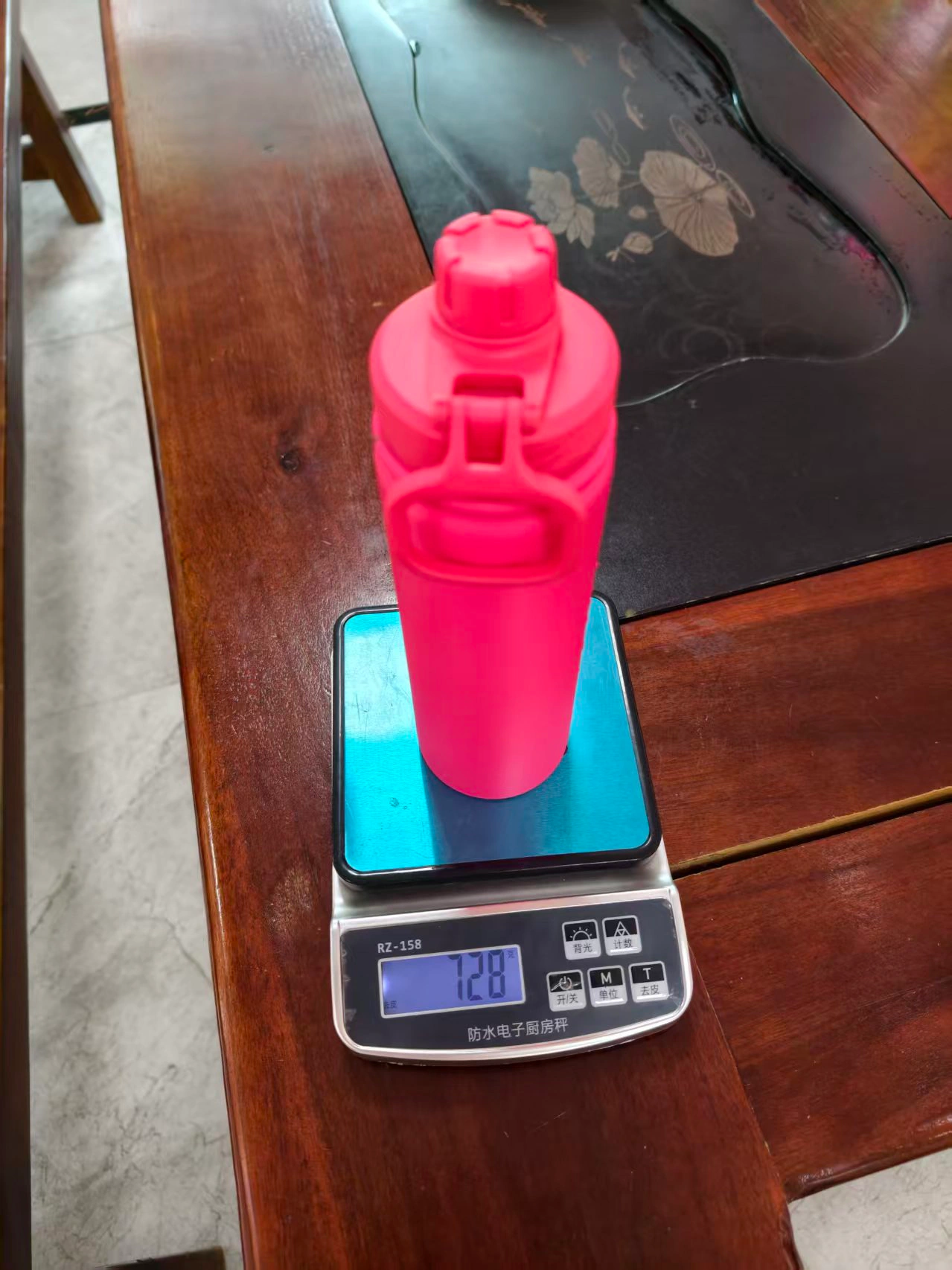
Compare empty assembled weight and filled handling separately. The photographed bottle is a separate sample, not a weighing record for the four-capacity series above. If a weighing method is used to determine water quantity, record the empty and filled readings on the same basis so the bottle and accessories are not counted as water.
Decide what the size is meant to solve. “More liquid,” “easier to carry” and “fits the required space” are different priorities. Put the primary one in the product brief so a larger number does not automatically win.
For how bottle size relates to daily water intake, see how many water bottles a day, by bottle size.
Which water bottle dimensions should you record?
Record named measurement points on the complete selected configuration. Capacity cannot determine the exterior size: body shape, wall construction and the chosen lid all affect the overall dimensions. At BG Drinkware, the stated height and weight include the lid and accessories, and mouth and base diameters are normally recorded.
A bare “diameter × height” entry is not enough if the diameter could refer to the mouth, body or base. Use the approved drawing to name each measurement and agree the acceptance tolerances for the order.
Height with lid
Measure from the base to the top of the assembled configuration. State whether a handle, loop or other movable part is raised or folded.
Base diameter
Name the footprint being measured. For tapered bodies, a narrow base does not describe the entire width that enters a holder.
Maximum body width
Record the widest relevant point and any handle or projection. Check the space through which the complete product must pass.
Mouth diameter
State whether the figure is the clear opening, the outer rim or another drawing reference. Do not confuse the lid’s outside diameter with the opening.
Empty assembled weight
Include the selected lid and supplied accessories. Compare the same configuration basis across the range.
Fit in the intended space
For a bag, holder or gift box, record the usable opening, depth and obstructions. Trial the complete sample instead of relying on capacity alone.
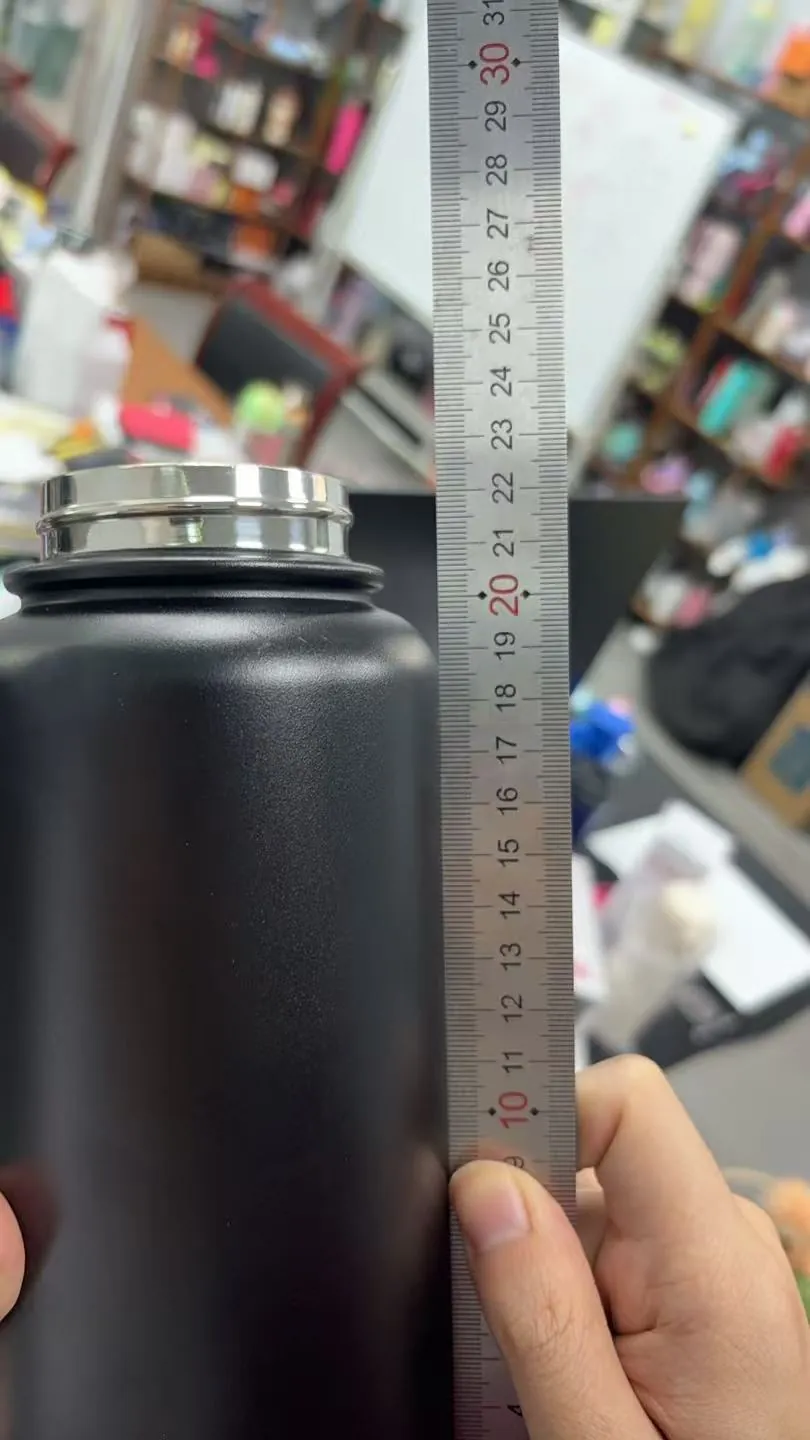
For a vehicle cup holder, base diameter is only a starting point. The holder’s depth, taper and nearby clearance can affect fit. Do not market a model as universally cup-holder compatible without evidence for that claim. Physical fit also does not establish spill or leak performance.
Agree the measurement points, dimensional tolerances and any required fit checks through the order-specific quality-control discussion.
For a well-known size range in ounces and millilitres, see Hydro Flask sizes.
What does actual bottle capacity mean?
BG Drinkware’s stated basis for actual capacity is water filled to the bottle’s rim: its brimful capacity. Write that fill point into the specification. It is different from a check filled only to the threads, or the liquid volume a user may choose to carry while leaving space below the lid.
Keep three entries separate when they matter to the project:
Listed or nominal capacity
The size used in the product description or catalogue. Confirm what the supplier means by that number.
Measured brimful capacity
The capacity at the defined rim fill point, checked on the selected sample using the agreed method.
Intended fill level
Any user-facing fill line or instruction for the selected design. Do not infer it merely by subtracting an arbitrary amount from the nominal capacity.
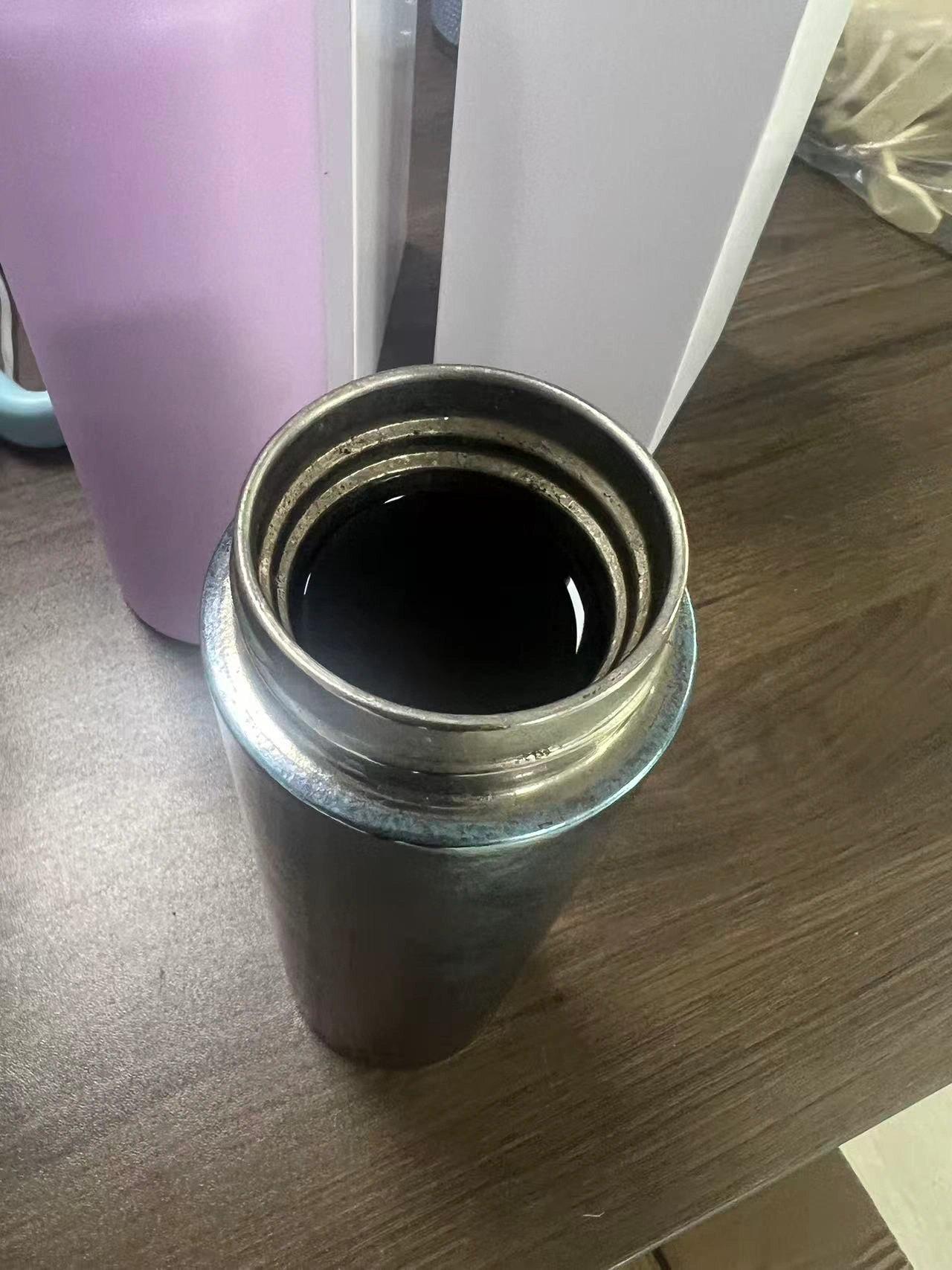
For a sample comparison, record the model and lid version, exact fill point, measurement method and result in ml. Keep a thread-level result separate from brimful capacity; neither automatically defines the intended everyday fill level. Use the same method for each candidate. A rounded fl-oz label or a product photograph is not a substitute for that record.
Case: keeping a tumbler design but switching from 20 oz to 12 oz
The customer liked the automotive tumbler’s styling, but its overall size was too large for the project.
The customer chose a smaller product with the same styling during the design stage.
BG Drinkware reports that this decision had no impact on production because the replacement was made during design. It was a size-selection decision, not a batch rework or a change made after manufacturing had started.
Buyer lesson: Review exterior dimensions while selecting the design, rather than choosing by appearance and capacity alone. This example concerns early size selection; holder fit still needs a separate check. The comparison graphic and measurement photographs are not identified as the customer’s tumbler and are not evidence of its holder fit.
Does a water bottle product line need every available size?
Not necessarily. Give each size a clear use in the product line. The four-capacity series illustrates the choices available, not a requirement to launch all four. A brand can first identify the main use case, then add another capacity when it solves a different carry or volume need.
A compact option
A candidate when overall bulk or handling matters more than carrying the maximum volume. Confirm the actual assembled size.
The core option
The model that best matches the main customer brief. Select it from the intended use and sample, not from a presumed universal standard.
A larger option
A candidate for projects that prioritise more liquid, provided its dimensions and filled handling remain suitable.
Before treating two sizes as one interchangeable family, confirm their lids, components, decoration area and packaging. Similar styling does not prove shared parts. Split the requested quantities by capacity so the factory can review the actual assortment.
For the commercial side of those choices, the guide to drinkware quotation cost drivers explains why construction, quantity splits and packaging need to be aligned. Size selection and price comparison should refer to the same configuration.
What should go in a water-bottle size brief?
Specify capacity and exterior constraints together. “500 ml bottle” alone leaves the height, width, lid configuration and measurement basis open.
- Intended user and use: gift, daily carry or sport
- Listed capacity and required actual-capacity method
- Maximum height with the selected lid and accessories
- Base diameter, widest point and named mouth measurement
- Empty weight with the complete supplied configuration
- Bag, cup-holder or gift-box constraints to trial
- Quantity split by capacity, lid version and colour
- Approved drawing, sample and order-specific tolerances
Compare those entries against a complete sample before final approval. If several capacities are included, keep a separate record for each one instead of copying a single set of dimensions across the series.
Compare water bottle lid types, fit and sealing alongside the selected size, and explore the broader buyer-resource articles for cleaning, leak checks and insulation. Those questions remain separate from the bottle’s size and should be matched to the selected design.
For smaller sizes in bulk, see custom small stainless steel water bottles.
For single sizes in detail, see the 16 oz and 24 oz water bottle guides.
Water bottle size FAQ: standard sizes, ml vs oz and fit
What is a standard water bottle size?
The featured family offers 350, 500, 750 and 1000 ml rather than one standard capacity. Choose for the intended use instead of assuming a universal size, then confirm the selected model’s lid-on height, width and weight.
Is a 500 ml bottle suitable for every child?
No. Around 500 ml is a selection pattern in BG Drinkware’s children’s and gift projects, not an age-based recommendation. Review the complete product’s handling and intended-user requirements.
Are 500 ml and 16 oz exactly the same?
No. 500 ml is approximately 16.9 US fl oz. A nominal 16 oz product name does not establish its measured brimful capacity; confirm the supplier’s stated basis.
Does the quoted bottle height include the lid?
BG Drinkware’s stated measurement basis includes the lid and accessories. Confirm the exact configuration and the position of any movable handle or loop on the order drawing.
Can capacity tell me whether a bottle fits a cup holder?
No. Check the base, body width, height and the holder’s usable space, then trial the assembled sample. Do not assume that two bottles with the same capacity have the same fit.
Can I change size while choosing the design?
Yes, discuss the smaller or larger candidate before production approval. In the reported 20 oz to 12 oz example, the customer changed at the design stage and production was unaffected; that is not a blanket promise for later changes.
Choose the capacity. Define the complete bottle.
Share the intended use, preferred capacities, maximum height and width, lid configuration, quantity split and packaging constraints. BG Drinkware can review candidate models and the sample details needed for your product line.
Discuss your bottle-size brief →