Bulk Kids’ Water Bottles: Packing and Receiving by Site
Before ordering kids’ water bottles for several sites, put each site's quantities, spare sets and carton marks on the packing list. At receipt, count complete sets and spares separately before handing bottles out.
By Feng, Head of After-Sales Service & Online Marketing Lead
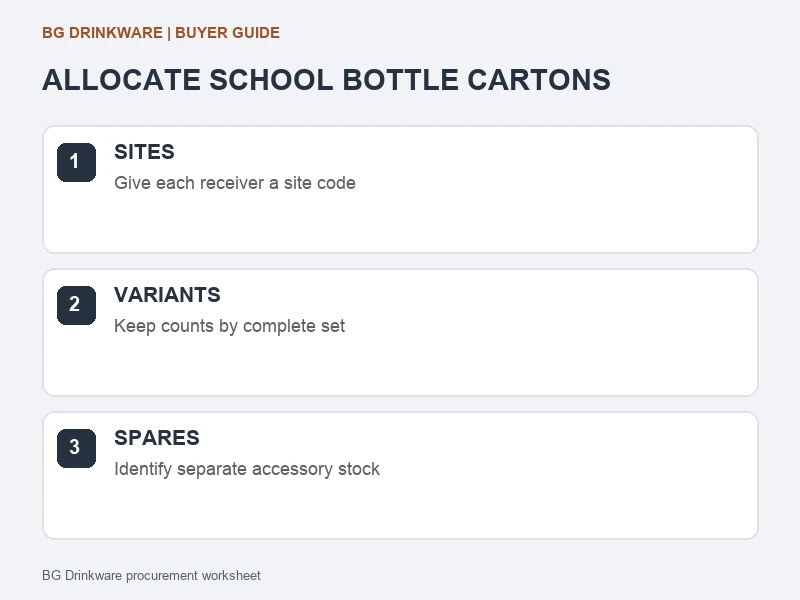
For bulk kids’ water bottles going to several receiving points, approve quantities by bottle variant and destination before packing starts. List complete bottles and spare parts separately. Assign every carton to a site code and use that code on both the carton mark and the packing list. BG Drinkware, a drinkware manufacturer in Yongkang, China, can pack and mark cartons by receiving point and provide a packing list or packing photographs for the agreed allocation. Give the supplier a dated allocation and ask who should approve any changes before dispatch. When the cartons arrive, check the carton numbers, quantities by variant and included parts against the same revision. A correct shipment total can still conceal a shortage for one site and an overage for another. Record discrepancies against the carton number, hold affected stock for review and share photographs of the label and contents when they help identify the difference.
What should the allocation list identify?
Give each receiving point its own code and record the quantities of each approved bottle variant at that site. Define a complete set in the order, including its lid and any agreed accessory. Record spare parts on separate lines so they cannot be counted as complete bottles.
A colour name may be enough for the person placing the order but ambiguous for a receiving team. Use the agreed model and variant code beside the colour description. If the same body can take several caps or sleeves, identify the whole configuration before calculating sets.
Record the variant totals and the site totals, then check the intersection of the two. Match the grand total to the PO. Give each site its own row so staff know which variants to issue on distribution day.
Related guide: Water Bottles for Schools: How to Order Reusable Bottles for Students.
How can a correct total hide the wrong allocation?
Check the quantity of each variant against its assigned site. For example, two sites can each receive their planned total even if their blue and green allocations have been swapped. The receiving team needs the site-level counts rather than just the shipment total.
| Destination | Blue sets | Green sets | Complete sets |
|---|---|---|---|
| Site A | 300 | 200 | 500 |
| Site B | 200 | 300 | 500 |
| Order total | 500 | 500 | 1,000 |
This illustrative allocation uses 500 blue and 500 green complete bottles of one model across two sites. The distribution counts describe packing instructions for an order already allocated by variant. They do not set a separate product minimum for each site. Different logos are counted separately for MOQ.
If the site A and site B labels were exchanged, both sites would still receive 500 complete bottles. Site A would be short 100 blue and over by 100 green. Site B would have the opposite discrepancy. Keep those differences on separate lines rather than netting them to zero.
When should variants share a carton?
Choose the packing arrangement around what the receiving team can check and distribute. A single-variant carton is easy to reconcile against one product line. A mixed carton can suit a site that needs a fixed assortment if the packing list identifies the contents and the receiver can verify them.
If a central warehouse will split the order locally, compare the time needed to sort single-variant cartons with the effort of checking mixed cartons at the factory. If the order goes straight to each site, give staff enough detail to separate their own stock from other destinations.
BG can pack by receiving point and add the agreed shipping marks. Ask for site code, carton number and a matching packing record. Agree which spares go in a separate carton and whether small spare packs must be identified inside a mixed carton.
Related guide: Custom drinkware purchase order requirements: PO attachments.
Which packing records should be approved before dispatch?
Approve one dated allocation revision, a carton numbering plan and the label wording. Ask for a packing list by receiving point and decide which photographs the team needs before dispatch. Match the carton references across the documents so each receiving point can check its portion of the order.
BG can provide packing lists or packing photographs by receiving point. Agree whether photographs should show the shipping marks, open carton contents or both. Use the packing list for the planned count and specify how the receiver should verify quantities and contents.
If a packing change creates a new carton or moves units between cartons, update the list before releasing the affected stock. Mark the earlier revision as superseded and notify the receiver who would otherwise check against it.
What should staff do when a carton arrives short?
Match the physical cartons to the packing list first, then check the contents using the agreed receiving scope. Record missing cartons separately from shortages inside a received carton. For each discrepancy, keep the site code, carton number, expected quantity, counted quantity and a record of who checked it.
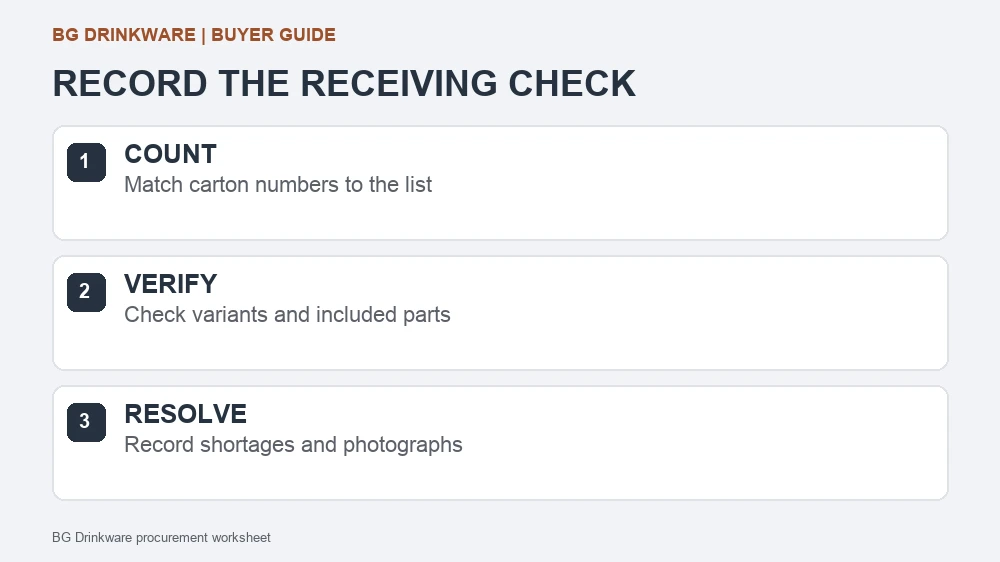
- Check the packing-list revision and carton numbers.
- Count complete sets by site and variant.
- Record additional spares separately.
- Send discrepancies with carton references.
Keep affected stock identifiable while procurement and the supplier review the difference. Photographs of the shipping mark, carton condition and contents can support the count. Check whether another carton number or delivery might explain the difference before reallocating bottles between sites.
For spare parts, check the quantity and the compatible bottle variant before adding them to replacement stock. When the order is reconciled, share the final counted allocation with staff who will distribute the bottles.
Related guide: Drinkware batch traceability: connect the order, production records and cartons.
Buyer questions
Do spare lids count towards the number of complete bottles?
Record replacement lids and other spares on separate lines. The lid included with a complete bottle remains part of that set. Identify each spare’s compatible model and carton so the receiver can count it correctly. Keep the spare quantity out of the number of bottles available for distribution.
Can BG mark cartons for different schools or sites?
Yes. BG can pack and mark cartons for different receiving points by agreement. Send the site codes, variants, quantities and mark wording with the order. Confirm the carton references and share the approved allocation and packing list with the receiver before the cartons arrive at each location.
Can I use a photo instead of checking the received cartons?
Use photos to identify the shipping marks or document the packing arrangement. Confirm the actual carton numbers, counts and condition at receipt according to the agreed inspection scope. If a count differs, record it against the specific carton and send the relevant photographs with the discrepancy report.
What happens if one site needs a different colour after approval?
Ask for an updated allocation and check which cartons need to be repacked or relabelled. Confirm any effect on cost and dispatch before agreeing to the change. Give the supplier and receiving team the same revised document so nobody checks the new cartons against the superseded list.
Keep one approved allocation for packing and receipt, with each change identified by revision.
Request a quote for a multi-site bottle order
Send the model, quantity by variant, destination allocation and requested spares. Include site codes, carton marks and which packing records each receiver needs.
Choose a kids bottle model before sending your specifications.
Request a quote