Why Does My Water Bottle Leak After Washing? Seal, Lid and Mould Checks
A bottle that was dry yesterday drips after a wash. In most cases the seal is the reason, and sometimes the lid itself no longer fits as it should. Here is how to tell which, how a factory tests lids, and one real case where one lid in six leaked.
By Feng, Head of After-Sales Service & Online Marketing Lead
Usually because of the seal. In BG Drinkware's experience, problems with the silicone seal ring are the most common reason a bottle or tumbler lid leaks, so after washing, first check that the seal is back in its groove, flat and seated all the way round. The second cause is the lid itself. A lid mould that has been used for a long time can wear, so the lid parts no longer fit together closely enough. The seal itself rarely loses its shape, because silicone is heat-resistant. BG Drinkware, a drinkware manufacturer in Yongkang, China, tests lids by filling the bottle with hot water, holding it upside down for 10 minutes and shaking it. In one order of car tumblers, a worn mould left about one lid in six leaking. Every lid was replaced with newly made lids that fit properly, which solved it.
What usually makes a lid leak after washing?
Two things, in this order. Most leaks come from the silicone seal ring: taken out to wash and put back unevenly, or not pushed fully into its groove. Less often, the lid parts themselves do not fit closely enough, which can happen when the mould that makes them has worn over a long production life.
The seal ring
The most common cause in BG Drinkware's experience. Check it is in the groove, flat and the right way round.
The lid parts
A worn lid mould can make parts that do not meet closely, so water finds a path between them.
Not usually the silicone
Silicone is heat-resistant, so a seal rarely changes shape from hot water or washing.
Usually not the steel body
A leak usually appears where the lid meets the body or through the lid itself.
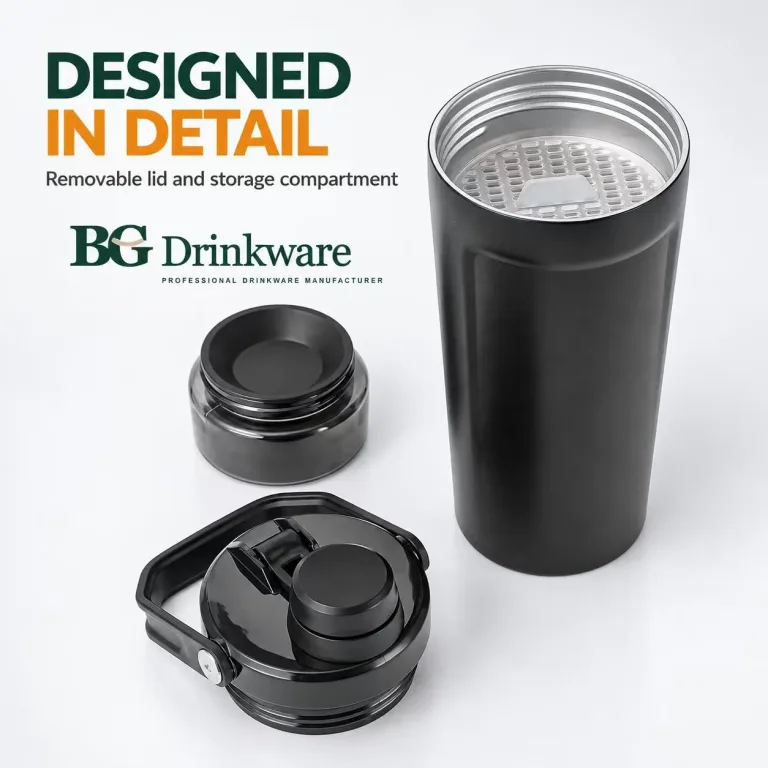
For the parts of a lid and what each one does, see water bottle lid types and tumbler lid, seal and straw checks.
How can you find out which part is leaking?
Refit the seal first, then test the bottle the way it leaked. If the leak stops, the seal was the cause. If it goes on, watch where the water appears: at the rim, between the lid parts, or at the drinking opening. A second lid on the same bottle is the quickest comparison.
- Take the seal out and refit itPress it evenly into the groove all the way round, so no part is twisted or raised.
- Fill the bottle and close itUse water at the temperature the bottle is used with, and close the lid as normal.
- Hold it upside downDry the outside first, then hold it inverted for a few minutes over a paper towel.
- Look where the water comes outAt the rim points to the seal or the lid fit; between lid parts points to the lid.
- Swap the lidIf another lid on the same bottle stays dry, the first lid or its seal is the problem.
For how to clean the seal and lid without damaging them, see how to clean a stainless steel bottle.
How does a factory test lids for leaks?
With hot water, time and movement. At BG Drinkware, the bottle is filled with hot water, closed and held upside down for 10 minutes, and it also goes through a shake test. The three steps mirror real use: hot drinks, a bottle tipped over in a bag, and movement while it is carried.
| Symptom | Likely cause | How to confirm | What to do |
|---|---|---|---|
| Leaks at the rim after washing | Seal not seated evenly in its groove | Refit the seal and repeat the upside-down test | Refit the seal; replace it if it is torn |
| Several lids from one batch leak | Worn lid mould; parts do not fit closely | Test more lids from the same batch on one bottle | Replace the lids with newly made lids that fit |
| Leaks between lid parts | Lid parts not meeting closely | Try a second lid on the same bottle | Replace the lid |
| Seal looks out of shape | Damage or stretching (uncommon) | Compare it with a new seal | Replace the seal |
For bulk orders, agree the leak test and the AQL sampling with the supplier before production. See leak-proof water bottles in bulk and AQL inspection.
What happened when one lid in six leaked?
On one order of car tumblers, BG Drinkware found that about one lid in six leaked. The seals were not the cause. The lid mould had worn, so the parts it made no longer fitted together closely enough. Every lid on the order was replaced with newly made lids that fitted properly, which solved the problem.
The lesson for a brand is that lid fit can change over the life of a mould, even when the drawing and the material stay the same. A lid that passed at the sample stage can fit less well after a long production run. That is why a repeat order should be checked against the approved sample, not assumed to match it. See golden samples for bulk drinkware.
What should a brand write into a leak-proof order?
Write the leak test into the specification: water temperature, how long the bottle is held upside down, whether it is shaken, and how many units are tested. Name the seal material and ask for spare seals. On repeat orders, check lid fit on the new batch against the approved sample.
- Test method: hot water, upside down for a stated time, plus a shake test.
- Sampling: how many lids are tested from each batch, and the AQL; BG Drinkware inspects to AQL 2.5 for major and 4.0 for minor defects.
- Seal: silicone, with spare seals ordered with the bottles.
- Repeat orders: compare lid fit on the first units with the approved sample.
The standard minimum order is 500 pieces, negotiable; a sample of an existing model takes up to 7 days, and bulk production takes 7–12 days after the sample is approved. For spare lids, see replacement water bottle lids, and for the checks in detail, quality control.
Leaking lid FAQ
Short answers to the questions people ask most about bottles and tumblers that leak after washing, seals that wear and how leak tests are done. The answers come from BG Drinkware's own production and after-sales records, including the leak test it runs on lids.
Why does my water bottle only leak after I wash it?
Washing is when the seal comes out and goes back in. If it is refitted unevenly, twisted or not pushed fully into its groove, water gets past it. Take the seal out, press it back evenly all the way round and test the bottle upside down before using it again.
Do silicone seals wear out or lose their shape?
Rarely. Silicone is heat-resistant, so hot drinks and washing do not usually change its shape. Check it for tears or stretching if the bottle still leaks after refitting. A seal that is damaged should be replaced; BG Drinkware supplies lids and silicone seals separately.
How long should a lid leak test last?
BG Drinkware fills the bottle with hot water, closes it and holds it upside down for 10 minutes, then runs a shake test. For a bulk order, agree the water temperature, the time, the shake test and the number of units tested with the supplier before production.
Can a lid leak even if the seal is fine?
Yes. If the mould that makes the lid has worn after long use, the parts may not fit together closely enough. In one BG Drinkware case, this left about one lid in six leaking on an order of car tumblers, and all the lids were replaced.
This guide is based on BG Drinkware's production and after-sales records. Related guides: a rattle inside an insulated bottle, why a water bottle smells and rust and tea stains.
Planning a leak-proof bottle?
Send the capacity, quantity, model, lid, colour, logo method, packaging, payment terms and trade terms, and the leak test you need.