Insulated Bottle Heat Retention Tests: What a Report Needs
Before ordering an insulated bottle, agree on the model, starting temperature, measurement times and pass criteria with the quality control team. Ask for results tied to the sample or batch tested.
By Feng, Head of After-Sales Service & Online Marketing Lead
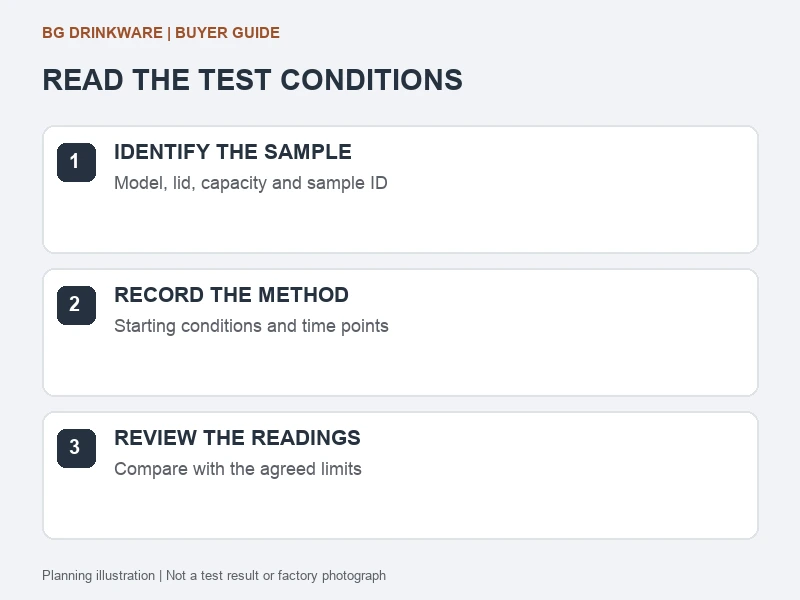
An insulated bottle heat retention test measures how the water temperature changes over an agreed period under stated conditions. To compare results, identify the bottle and lid, starting water temperature, fill quantity, room conditions and measurement procedure. A six-hour value without those details is an incomplete basis for a purchasing decision. BG Drinkware, a drinkware manufacturer in Yongkang, China, can arrange testing and records according to the order; it does not provide one fixed standard set of six-, twelve- and twenty-four-hour records for every order. Agree the required time points, sample quantity, acceptance limits and report format in advance. Keep appearance and inner-body inspections separate from temperature measurements, because they establish different things. Review individual sample readings and any departures from the agreed method before approving the result. The report should identify the tested configuration closely enough to connect it to the product you are buying.
What does a heat retention result actually describe?
A result describes a particular sample tested under particular conditions. It should identify the water temperature at a stated elapsed time, together with the initial conditions. A claim such as hot for twelve hours needs more detail before procurement can use it as an acceptance requirement.
Ask what temperature counts as meeting the claim and which configuration was tested. The lid, capacity and fill quantity belong in the description alongside the model number. Keep a copy of the method with the result so another person can understand how the measurement was obtained.
For example, Zojirushi states that the heat-retention rating for its SF-CC bottles uses water starting at 95°C in a room at 20°C. That is a published example of conditions attached to a rating. It is not BG Drinkware's test procedure or a universal acceptance threshold for other bottles.
Which fields should you request in the report?
Request enough information to identify the sample and reproduce the agreed comparison. The report needs both the test conditions and the readings. Use a blank field list before testing, then check that the completed record contains actual values rather than only a pass mark or a marketing claim.
| Field | What to record | Why the buyer needs it |
|---|---|---|
| Sample identity | Model, capacity, lid, sample ID and order reference | Connects the result to the configuration |
| Starting conditions | Water temperature, fill quantity and preparation | Defines the beginning of the test |
| Environment | Room temperature and relevant conditions | Supports comparison between runs |
| Measurement method | Instrument, time points and opening procedure | Shows how readings were obtained |
| Results | Individual readings, elapsed times and deviations | Allows review against the agreed limits |
| Acceptance | Limits, decision and reviewer | Connects the result to the order requirement |
Record whether the tested item is a development sample, an approved pre-production sample or a unit selected from the production order. Those descriptions should not be used interchangeably. A sample result only identifies what was tested; the agreed sampling plan determines how it contributes to the order decision.
Ask the test provider to identify the instrument and its relevant calibration or verification status. Do not fill missing fields from assumptions about how a supplier normally works. Resolve gaps before using two reports to rank products.
Related guide: Golden Sample: How Brands Keep Bulk Drinkware Matching the Approved Sample.
Related guide: AQL Inspection for Drinkware: Levels, Sample Sizes and What Gets Checked.
How should six-, twelve- and twenty-four-hour readings be planned?
Choose the time points that serve the intended claim or purchasing requirement, then agree how each reading will be taken. Confirm whether the procedure uses separate samples for different times or repeated measurements of the same sample. Opening history belongs in the method and should be recorded.
If the same bottle is opened repeatedly, that sequence needs to be part of the agreed procedure. A result from a bottle left closed until its final measurement should not be treated as directly equivalent to a different opening sequence without reviewing the method. Specify any pouring or refill steps if they are part of the use case being evaluated.
Keep a claim-validation test separate from a simulation of daily drinking. Both can answer useful questions, but they involve different conditions. Ask the provider to describe the procedure before testing rather than adding a convenient explanation after a result has been received. Use safe handling arrangements appropriate to the hot-water test.
Related guide: How Long Does a Thermos Keep Coffee Hot? How Vacuum Bottles Are Tested.
Related guide: Custom Insulated Water Bottles: What to Specify So Performance Matches the Claim.
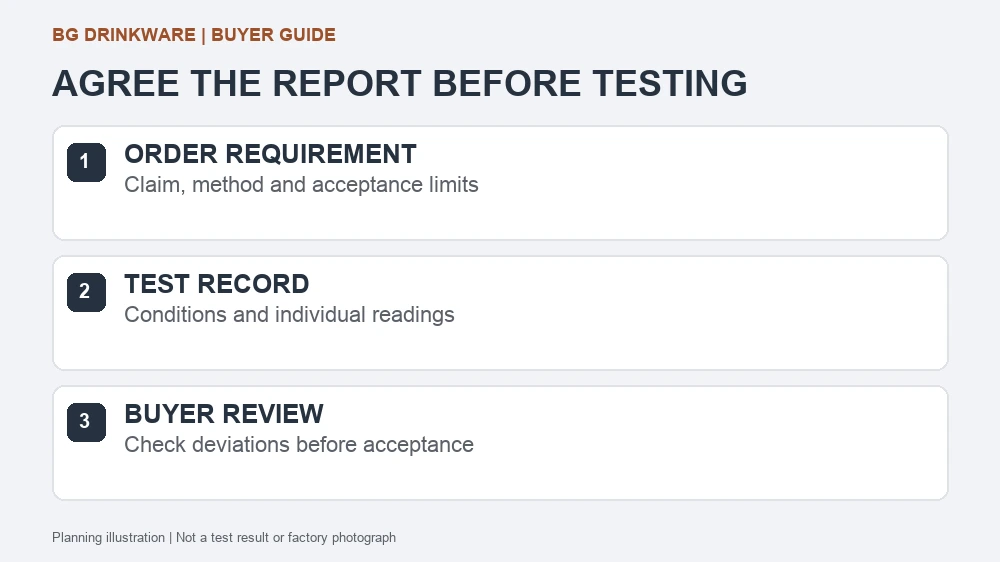
What testing and records can BG Drinkware arrange?
BG Drinkware commonly checks heat retention with water starting at 95°C and a reading after 6 hours. Special test requirements and records are agreed for the individual order. There is no fixed standard package of six-, twelve- and twenty-four-hour records supplied for every order. Send the intended requirement before ordering and confirm the agreed method, record format and work scope.
BG Drinkware also checks appearance and the inner body on its inspection and packing lines. Those checks concern the condition of the product and should be described separately from a timed heat retention test. They do not establish that a temperature record exists for every individual bottle.
Ask which samples will be tested, who will record the results and when the report will be available. Confirm any costs or schedule implications in the quotation. If your buyer requires an independent laboratory report or a named test standard, state that requirement explicitly and confirm whether it can be arranged for the order.
How should you review a result below the agreed limit?
First check that the sample and procedure match the agreed test. A low reading alone does not identify the cause. Review the configuration, initial conditions, elapsed time and measurement record before deciding whether a repeat test, product investigation or change to the order is needed.
Keep the original reading in the record if a test is repeated. State why the repeat was requested and what changed, including any different sample or method. Replacing a low result with a later passing value would remove information the buyer needs to understand the decision.
Agree how failed samples and unresolved results affect release of the order. The action may depend on the cause and the agreed acceptance plan. A brief inspection of appearance or the inner body cannot resolve a disputed temperature result on its own. Where a product investigation is required, retain the identified sample and its test history.
Related guide: How Do You Know If Your Insulated Bottle Has Lost Its Vacuum?.
What should go into the purchase order attachment?
Attach the test requirements before the work begins. State the configuration, sampling arrangement, time points and acceptance limits, followed by the record format and response to failures. Ask the supplier to confirm the attachment so both sides are working from the same version of the requirement.
- Product model, lid configuration, capacity and sample selection method.
- Preparation, starting water temperature, fill quantity and environmental conditions.
- Measurement procedure, instruments and required elapsed-time readings.
- Acceptance limits, treatment of deviations and handling of failed results.
- Report fields, responsible party, delivery timing and any separately agreed cost.
Use limits justified by the specification or claim you intend to make. Do not copy a different brand's temperature threshold solely because its bottle has the same nominal capacity. If a formal standard is required, identify the applicable edition and obtain the complete method from the test provider.
Keep the approved attachment with the sample record and final report. A change to the lid or other configuration should trigger a review of whether the existing result still covers the order. Confirm that decision before repeating the performance claim on packaging.
Related guide: Custom drinkware purchase order requirements: PO attachments.
Related guide: Drinkware order changes after approval: a buyer's record.
Buyer questions
Does BG Drinkware provide a standard 24-hour report for every order?
No. BG Drinkware can arrange testing and records according to the order, but it does not provide one fixed set of six-, twelve- and twenty-four-hour records for every order. State the time points, sample quantity and record format you need before ordering, then obtain confirmation of the agreed scope.
Can I compare two bottles using only their six-hour temperatures?
Check the test conditions before comparing the values. The model configuration, starting water temperature, fill quantity, environment and measurement procedure should be identified. If those conditions differ or are missing, the two values may not support the comparison you want. Ask for the method and sample details with each result.
Do appearance and inner-body checks prove heat retention?
No. Appearance and inner-body inspections examine different aspects of the product from a timed temperature test. BG Drinkware carries out those inspections on its inspection and packing lines, while heat retention testing and records are agreed by order. Request the relevant temperature measurements when the purchasing decision depends on thermal performance.
Who decides the passing temperature?
The acceptance requirement should be agreed before testing, based on the product specification, intended claim and any applicable test requirement. Record the limit with the method and time point. A supplier's pass mark is not enough on its own if the buyer cannot see which conditions and threshold were used.
This guide is a purchasing and report-review checklist. It does not prescribe a universal test standard or passing temperature. BG Drinkware's testing and record requirements are agreed by order.
Define the test your order needs
Send the model, lid configuration, intended performance claim, required time points and report fields. Include any specified test method so BG Drinkware can confirm the testing and records available for your order.
Discuss the inspection scope before sending your specifications.